


The University of New Mexico community came together recently to discuss a topic that has rapidly become omnipresent in today’s world — artificial intelligence.
The UNM AI Conversation Kickoff event on Sept. 3 brought together a wide mix of faculty, staff and students throughout the day to explore topics through presentations, group activities and panel discussions.
Among the topics discussed were teaching, learning and student success; research, scholarship and creative work; administration, operations and institutional knowledge; human judgment and consequential decisions; privacy, security and data stewardship; careers and the future of work; and access, equity and sustainability.
Mark Emmons, dean of the College of University Libraries and Learning Sciences, chairs the steering committee on AI and kicked off the day by explaining the charge of the committee and some of the work that has been accomplished thus far.
“Our goal is to create a campuswide conversation about AI,” he said. “We want to listen before we act. This is not simply about adopting new tools or developing quick policies. It’s about how AI can support UNM’s mission and values, where AI use makes sense and where it does not, and what responsibilities come with our choices.”
More than 200 people attended the event, which included opening remarks from Barbara Rodriguez, provost and executive vice president for academic affairs, who charged the AI steering committee in February.
She said many questions surrounding AI come down to trust — using the technology in a way that enhances our mission and processes, yet preserves our community.
“How do we preserve what is distinctly human? Judgment, curiosity, creativity, empathy, connection and care,” Rodriguez said. “These aren't questions we can answer once and consider the work finished. The technology will continue to change, and so will the questions before us.”
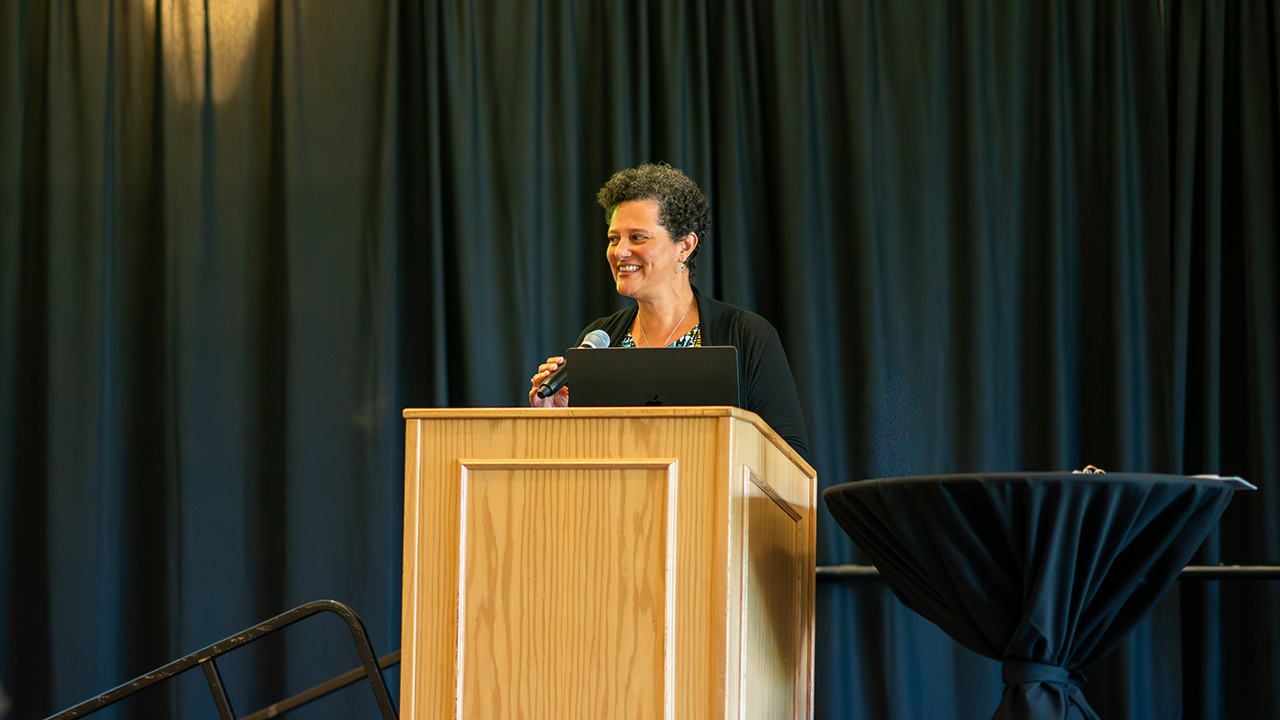
The keynote speaker was Melanie Moses, distinguished professor in the Department of Computer Science. Her talk was titled “Can We Build Trustworthy AI at Scale?”
She began by addressing the subject of her presentation.
“Can we trust artificial intelligence at scale the way that we're going right now? No, we can't trust artificial intelligence at scale on the path we're currently on. And so the question I really want to say is, how can we create artificial intelligence that is trustworthy, sustainable, empowering for everyone? And I'm going to say that I don't have a full answer to this question.”
She described concerns about the speed at which technology is moving; the lack of guardrails, ethical frameworks and policies; the concerns about who is profiting from these technologies; as well as how AI could impact the environment if large data centers are powered by fossil fuels.
Moses said that while AI is rapidly evolving, humans still have time to shape a future that works for all. That could include solutions like powering data centers from renewable power sources like solar, in addition to slowing down the pace of progress so that humankind has an opportunity to ponder these issues before they get ahead of us.
“There are just an enormous number of imaginative ways that we can embrace this technology. It doesn't have to be everyone,” Moses said. “For some of us, maybe the right solution is to unplug and grow our own food. But I think the most important thing for everyone to think about is what is your priority? How are you going to shape the future?”
“Our goal is to create a campuswide conversation about AI. We want to listen before we act. This is not simply about adopting new tools or developing quick policies. It’s about how AI can support UNM’s mission and values, where AI use makes sense and where it does not, and what responsibilities come with our choices.”
— Mark Emmons, dean, CULLS, and AI steering committee chair
Stephanie Moore, a faculty member in Organization, Information and Learning Sciences (OILS), organized and moderated the student panel on AI, said that there are common misperceptions about students in regard to AI that she feels that it is important to clear up, including how accepting students are of the technology that has quickly entered into their lives.
The panel included both undergraduate and graduate students from a broad range of programs: the School of Law, the School of Engineering, the College of Arts and Sciences, and the Ellis School of Business Leadership.
Students expressed the need for clear policies regarding AI use in classrooms, saying it can be inconsistent and confusing depending on the classes. Students cited both positive and negative ways to use AI in classwork.
Nathaniel Steen, a physics undergraduate, said that he has experienced some beneficial uses of AI in his schoolwork.
“I don't learn in one specific way,” he said. “It takes sometimes a lot of different perspectives for me to fully learn something, and AI can turn a two-day job into a 30-minute job … AI can walk me through it through multiple perspectives and give me that understanding that I need. So in a way, it can be like a private tutor and it can cater to different learning styles.”
There was also a discussion about how AI is impacting trust in the classroom — both among instructors and students.
Jocelyn Dailey, a Ph.D. student in electrical engineering, focused on the perception that some have of students due to AI’s availability and use.
“I remember feeling bothered and even continuing to this day to some extent to feel bothered by a sense that faculty think students need or want lower expectations, because in general we do not,” Dailey said. “In fact, many of us wish we would be asked for more ... Some of us don't want at all to be using these tools that we're being encouraged to use because we want the sense of satisfaction that comes from doing something for ourselves. We are not uniformly here for a degree. We care about the things that lead up to it. We want to learn.”
The day concluded with a visioning session — led by Vanessa Svihla, a professor in OILS and a Presidential Teaching Fellow — that involved group work, with participants getting out a pen and paper to express visually how thee see the world changing from AI and exploring how decisions made today could shape or change that future.
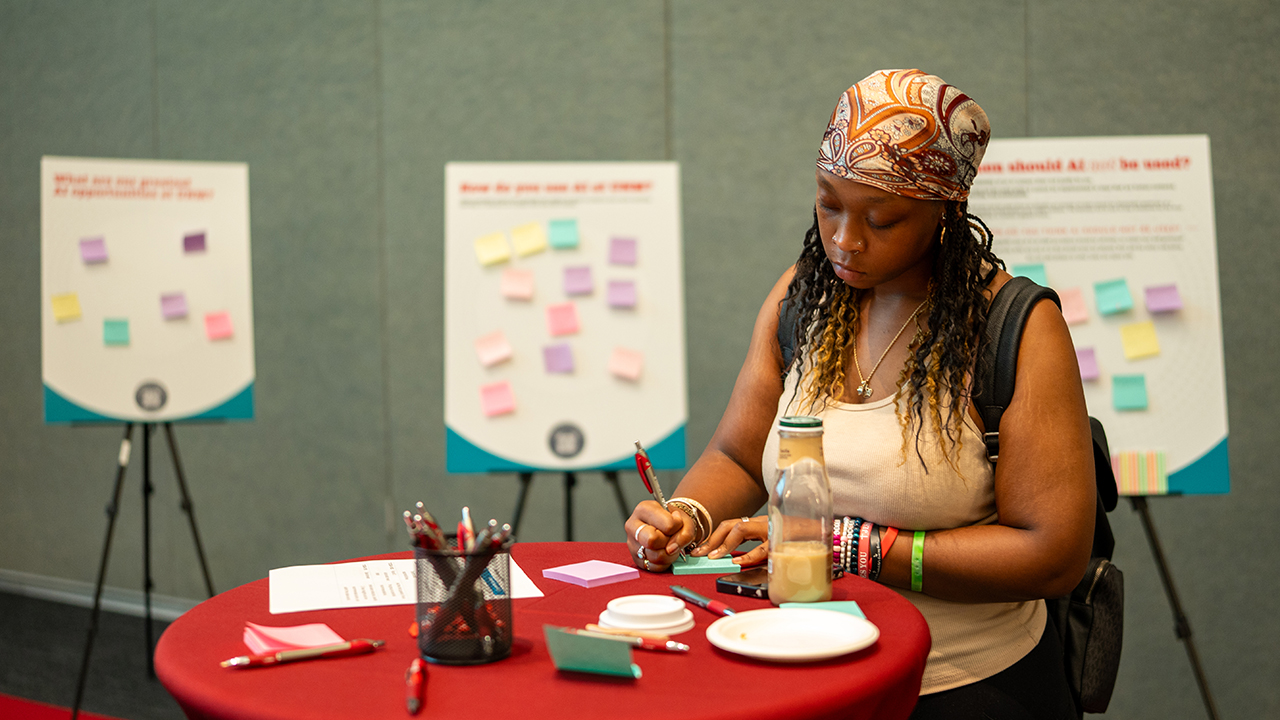
Throughout the event, the community had an opportunity to provide feedback on the proposed strategic ethical framework, encouraging attendees to provide ideas about how UNM can ensure that AI will advance UNM’s commitment to promoting discovery, inclusiveness and engagement with our communities. Feedback can also be submitted online. Recent updates on AI at UNM include the launch of a new website for AI efforts at UNM. Housed on the website are guidelines and policies (including the draft of the Statement of Values, Ethics and Principles), surveys and feedback forms, news and events, and information about the steering committee and its work. There are also videorecordings of some of the sessions during the kickoff, including Provost Rodriguez’s welcome; Melanie Moses’ keynote; and the student panel discussion.
This summer, Eva Lipton-Ormand joined as UNM’s inaugural AI project manager. Her role includes working with the steering committee as additional events and initiatives are planned and transitioning UNM’s AI efforts from a steering committee phase to helping ensure that policies and practices are integrated into UNM operations.
Also this summer, a survey was emailed to staff to get their feedback and thoughts on AI. On Sept. 1, surveys for faculty and students were distributed via email, and are open until Oct. 11. The survey feedback will be crucial in informing policies and decisions made on AI.
Emmons said that over the coming months, the process will include governance and broader strategic directions on AI.
“The kickoff was the beginning of the conversation, not the end of it,” he said. “We want to hear from people across UNM, learn from their hopes and worries, and use their input in the spring to develop practical governance and strategic direction that reflects who we are as a university.”
For more information, visit UNM AI Resources.


