

The University of New Mexico’s Assistant Professor Marisa Repasch has been awarded the 2025 Early Career TUNDRA Award—short for Toolik Userdays for Naturally Developing Research Abilities—in recognition of her promising field-based research in Arctic permafrost landscapes.
The TUNDRA Award provides early career scientists with research support in the form of “user days” at Toolik Field Station, a remote, world-renowned research hub located on Alaska’s North Slope. Awardees receive logistical support, accommodations, meals, and field equipment to help launch innovative pilot studies in Arctic environments.
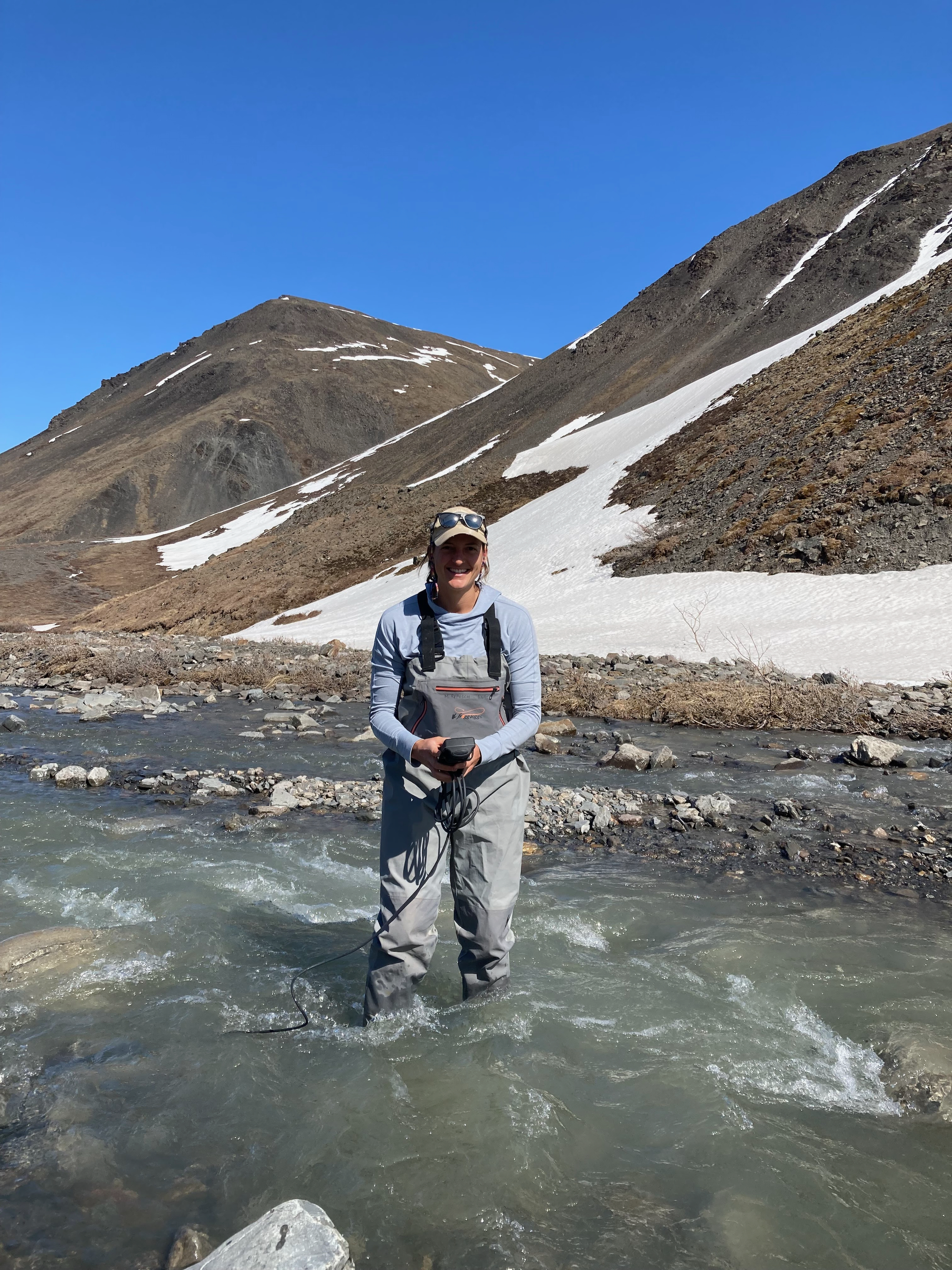
Repasch, a faculty member in the Department of Earth & Planetary Sciences, studies how surface processes like erosion, sediment transport and chemical weathering interact with the global carbon cycle—especially in the Arctic, where permafrost thaw is accelerating due to climate change.
“This award allowed us to go to the field together for the first time and collect a sample set for a pilot study, which will be used to develop future proposals—and the results may be publishable on their own,” Repasch said. “I also don’t currently have research funding to return to the Arctic for a large project, so the TUNDRA award enabled me to get back to the field with limited resources.”
In June, Repasch traveled to Toolik Field Station with collaborators Preston Kemeny of the Woods Hole Oceanographic Institution and Marc Dumont of the Colorado School of Mines. The team conducted a multi-day field campaign in the Atigun River watershed, collecting river and stream water samples, suspended sediment, bedrock cores, and electrical resistivity data.
“The samples and data we collected will be linked to understand how the depth of permafrost thaw influences the depth of chemical weathering—and therefore the oxidation of rock organic carbon and sulfide minerals like pyrite,” Repasch explained. “These processes have important implications for atmospheric CO₂ and water quality.”
The trip marked the first direct collaboration between Repasch and Kemeny, who begins a faculty position at Woods Hole this fall. Kemeny’s background in stable isotope geochemistry, especially in tracing dissolved ions like sulfate and carbonate, complements Repasch’s expertise in landscape processes. Together, they recently submitted a proposal to the National Science Foundation to expand their pilot study into a multi-season investigation of the Arctic carbon cycle.
“My collaborator Preston has been studying water chemistry in permafrost-affected watersheds since his Ph.D. at Caltech,” Repasch said. “It was a great experience to work together in the field, think about the landscape, and discuss new ideas for this research.”
Samples collected from the field campaign are now being analyzed at UNM’s Center for Stable Isotopes and the Analytical Geochemistry Labs.
“It is amazing to be at a university where these state-of-the-art analytical facilities are accessible to both faculty and students,” she added. “We are fortunate to have these labs staffed by dedicated research scientists who maintain the instruments and ensure high-quality data.”
The pilot campaign is also creating valuable training opportunities for UNM students. Repasch plans to involve a new master’s student in sample analysis, with opportunities for undergraduate research as well.
“The findings from this work will help us better model how landscape change in Arctic mountain regions influences the carbon cycle and atmospheric CO₂,” Repasch said. “That has broad implications not just for climate science, but for understanding how Earth’s surface responds to rapid environmental change.”


