When Kamyrn Zachek began as a freshman at UNM, there’s a good chance that she may have expected to find a faculty mentor. However, this economics and philosophy student might not have guessed that that mentor would be in a completely different field: engineering.
Now, as Zachek earns her bachelor’s degree this month and heads off to pursue a career in law, she carries with her the benefits of working closely with someone with different, yet similar, interests.
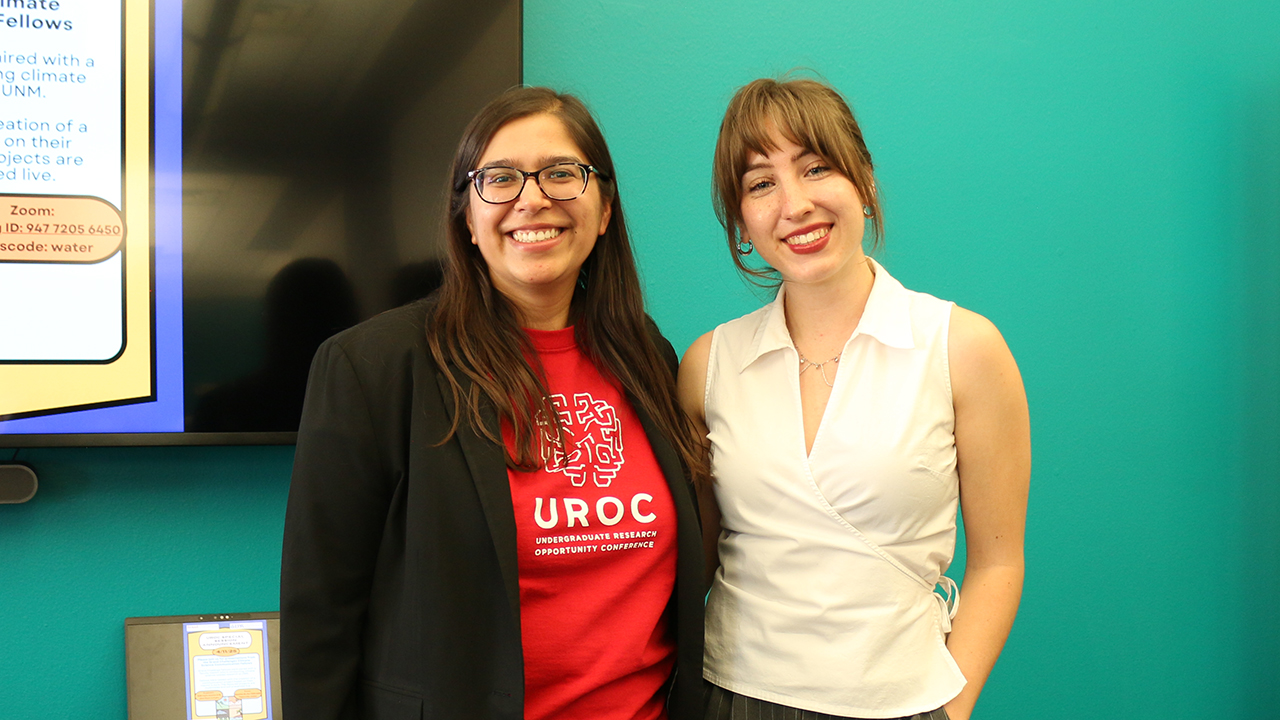
Her mentor is Anjali Mulchandani, an assistant professor in the Gerald May Department of Civil, Construction and Environmental Engineering, founded the Grand Challenge Undergraduate Water and Climate Science Communication Fellowship. The program, which pairs undergraduate students with faculty mentors who study water resources to develop a communications project based on their research, takes place during the Undergraduate Research Opportunity Conference (UROC) in the spring.
Zachek, a Regents scholar, first met Mulchandani in 2022 when she was accepted into the fellowship her freshman year of college. It was not until after the conclusion of the fellowship that year that another fellow from the cohort mentioned that Mulchandani was looking for an undergraduate student to join the team. Zachek had an interest in undergraduate research, so she was interested in this opportunity, and Mulchandani had been impressed by her eagerness and dedication during the inaugural event.
“Seeing how Kamryn was the epitome of the mission of the fellowship, I hired her in fall 2022 as the undergraduate lead for the fellowship,” Mulchandani said.
Zachek said she was initially brought on to act as a student lead for the fellowship, handling things like day-to-day communication with the fellows, helping organize cohort meetings and other clerical work.
“As time went on, I began to assume more responsibility within the fellowship and was eventually looped into the research project associated with the fellowship [looking at how the fellowship impacts students’ research identity and self-efficacy, as well as increasing interdisciplinary partnerships]. This is when I feel like Anjali’s role as my mentor began to supersede that of my employer,” she said.
Mulchandani hired Zachek as an undergraduate research assistant in summer 2023, a position she has maintained since.
“She has been the driving force behind the Grand Challenge Water Science and Climate Communication Fellowship and exemplifies the idea that students who participate in interdisciplinary undergraduate research grow with respect to personal confidence, ownership of their project, and identity as a researcher,” Mulchandani said.
Despite having no previous technical writing experience and having only in-class statistical analysis training, Zachek was being tasked with these rather scary duties.
“I was so terrified of beginning to work on this research project! In the beginning I remember feeling like I had gotten in way over my head and that I would never be able to produce the kind of work that Anjali was expecting from me,” she said.
However, that project became a valuable learning experience, both for Zachek’s technical skills as well as her developing mentor-mentee relationship.
“One of the many reasons that Anjali is such a wonderful mentor is that she never made me feel like I was not capable of getting where she wanted me to go in terms of my research skill set,” she said. “None of my questions were ever stupid, and in those instances when I was missing the mark, her corrections were never condescending. She always took the time to recognize that I was working hard even when I didn’t get it quite right.”
As a mentor, Mulchandani said it was a pleasure to have a student like Zachek working with her.
“She is among the brightest undergraduates at UNM, and it has been my distinct privilege to work with her,” she said. “Kamryn brings a level of creativity that bridges science communication, education and multi-disciplinary traineeship in new ways.”
The paper, “Promoting Undergraduate Student Self-Efficacy in Research through Participation in a Multidisciplinary Science Communication Fellowship,” was published in an American Society for Engineering Education (ASEE) journal in May 2024. She was also able to present the paper at an ASEE conference last summer. And thanks to that research project, in 2024, the duo received the UNM Faculty Mentored Research Award by UNM’s Office of the Vice President for Research.
Zachek said that working with a mentor in a different discipline benefitted her in ways she never expected.
“Even though my first degree is in economics, the kind of analytical thinking needed to succeed in the more math-based disciplines has never come easy to me. I think that before working with someone in engineering, I had this preformed judgment about the way that the kind of people who succeed in that degree operate. I think the most surprising thing about working with Anjali was learning how similar we are! Our intuition as to how best to approach problem solving is often quite similar.”
Zachek said that even though she is not pursuing engineering as a career, she will use the skills she learned from her mentor the rest of her life.
“Anjali has made me a better writer, researcher, student and young professional,” she said.
She said Mulchandani also provided invaluable guidance in how to mentally manage a demanding workload, how to deal with burnout, the importance of setting boundaries with your work, and how to stay positive in the face of adversity.
“I was a supremely unconfident freshman student, and I attribute much of my increases in self-confidence over the last three years to Anjali’s mentorship,” Zachek said. “She saw my potential and pushed me to become the student/researcher that I am today. I remember thinking, if she could believe in me, then I could believe in me.”


