
This week, educators from across the state are gathering at The University of New Mexico to learn how to help their students connect to New Mexico history and Chicana & Chicano Studies. The Initiatives for Student-Engaged Educations Ecosystems (ISEE) COLLEGE! program aims to connect schools, teachers, and Chicana & Chicano Studies (CCS) faculty to create curricula specific to student needs and local history, traditions, and communities.
The pilot program began in 2016 with the goal of creating an education ecosystem that would impact K-12 schools, student engagement, college enrollments of first-generation students, and teacher engagement and professionalization. Through this, students can take dual-degree classes (up to 12 college credits per student) that can help pave the way for those students to go to college.
Although participating teachers are not required to hold a master’s degree, the majority of them are currently enrolled in online advanced educational opportunities in CCS and other online master's or Ph.D. degree programs at UNM.
“We’ll do drop-in visits with them to do some observation, but it’s really nice that students know their instructor because it allows them to keep that report and focus on the lesson,” said CCS Operations Specialist Rebecca Martinez-Baca.
Alicia Camacho is a teacher at Atrisco Heritage Academy who has participated in this program before. She said it’s encouraging to see students feel comfortable enough to engage with the material.
“Students will say that the overall space and curriculum reminded them of home. It’s easy to find parallels between their own lives and the course so they don’t feel out of place,” said Camacho.
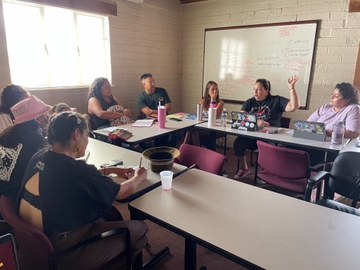
Atrisco Heritage Academy is one of 10 schools collaborating with CCS for the ISEE COLLEGE! Program. For the past three summers, CCS has invited teachers for a week-long workshop to engage in discussion and planning related to college, career, and civic readiness, develop strategies for student success through social emotional learning opportunities, access resources regarding New Mexico heritage communities, and identify experiential learning activities.
“My students that are not typically college-bound in their head, academically they are good, but they automatically assume their only option is going to work after graduating,” Camacho said. “One of my favorite things about it is seeing the kids who typically don’t see themselves at college begin considering it.”
Additionally, participating teachers co-publish an article that will be featured in an upcoming book titled Towards Educational Liberation for Latine/x/o Youth: An Intersectional Approach.
Martinez-Baca said when teachers are interested in participating in the program, it’s always helpful to have their principal on board. “I think it’s important that people understand the work and effort these teachers put in, and the heart and soul they put into their work. It’s a labor of love.”
For more information on the ISEE COLLEGE! Program, email Martinez-Baca or ISEE Education Development Representative Gabino Noriega.


