


New Mexico’s wildfire-ravaged forests could receive a much-needed boost in recovery efforts through this year’s GO Bond 3, which would provide critical funding for Phase 2 at the New Mexico Reforestation Center (NMRC), a multi-site initiative including New Mexico State, New Mexico Highlands and The University of New Mexico. The Center is designed to dramatically expand New Mexico's capacity to restore forests damaged by wildfire, drought and climate impacts.
With voter approval, the bond would provide $17.65 million to NMSU and the NMRC, including $600,000 to UNM in support of the Center. The funds would help construct an equipment storage building and a Greenhouse 3 addition to produce 1.25 million additional seedlings annually as part of a project to develop a reforestation economy and restore New Mexico’s forests and the ecosystems they provide.
The NMRC is designed to position New Mexico as a leader in wildfire mitigation and recovery by creating a complete reforestation pipeline and setting an example of how to build one from scratch. As New Mexico gets hotter and wildfire risk increases each year, NMRC is important to the state's future.
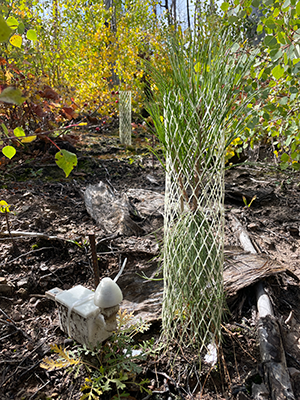
Trees can restore ecosystem stability, reduce erosion, and break the cycle of degraded brush fields that fuel future fires. However, natural tree regrowth is rare in areas that have burned hot, which makes NMRC a proactive strategy to help limit future devastation.
Public support is crucial to making this center a reality, as private funding alone is not enough to build the center. The volunteer advisory board has developed a five-phase funding approach.
This funding is critical to keep NMRC construction on track to meet the state’s reforestation needs. New Mexico is quickly losing the window to plant seedlings in viable locations where they can survive, making this an urgent project.
“If we wait another 15 years to build this facility to capacity, we will have a lot less land area to reestablish trees in, but if we do it now, we can reforest more of our landscape,” said Matthew Hurteau, a UNM biology professor and one of the seven advisory board members helping to keep New Mexico green.

Hurteau said that “New Mexico needs a minimum of 5 million tree seedlings to be planted each year to make up for what wildfires have taken.” Currently, New Mexico produces about 300,000 seedlings per year, leaving a clear and significant gap.
When the Center is fully operational, it will produce up to 5 million seedlings per year, which would not only meet the state’s needs but also create a surplus in years when it is not possible to plant all 5 million. NMRC can then sell the surplus to out-of-state buyers, boosting the economy through revenue and jobs.
NMRC will manage or support each stage of the growing, planting, and evaluation process, including collecting seeds and cones, building and maintaining a seed bank, processing and cataloging all seeds, determining which seeds to plant, growing seedlings, hardening seedlings so they can survive outdoors, and monitoring survival. It will also work to improve models that predict where to plant most effectively over time and to develop the workforce needed to carry out reforestation.
The recent flash flooding in the Grand Canyon is an example of how wildfires can alter landscapes and increase the risk of future disasters. According to UNM Professor Emerita Laura Crossey, the Grand Canyon flooding was so devastating because the 2025 wildfire that burned in the area removed natural disruptions to water flow, such as trees, bushes, rocks, and mud, so the water hit human infrastructure.
Lessons from events like this make the NMRC project even more timely and important. In the last 20 years, wildfires in New Mexico have burned over 5.45 million acres of forest, including over 900,000 acres in 2022 alone.
"If we wait another 15 years to build this facility to capacity, we will have a lot less land area to reestablish trees in, but if we do it now, we can reforest more of our landscape.”
– Matthew Hurteau
The advisory board, which includes Hurteau and seven environmental professionals and researchers from across the state, has come together to help make New Mexico more fire-resilient and improve conditions for all New Mexicans.
The research institutions represented on the board include UNM, New Mexico State University, New Mexico Highlands University, New Mexico Division of Forestry, and the New Mexico Forest and Watershed Restoration Institute, which is embedded at Highlands.
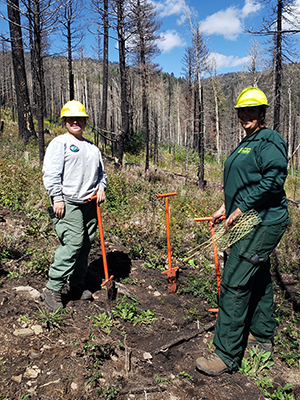
“We have broken up the work amongst us by expertise,” said Hurteau. “We need a collaborative effort, where everyone brings different skill sets and knowledge bases to the table.”
Hurteau has helped guide the project’s strategy and development, advocates for it with policymakers, and will contribute UNM research through his Center for Fire Resilient Ecosystems and Society to provide predictive models that help determine where seedlings should be planted for the best chance of survival.
“Not only is it important to know how to grow seedlings, but it is key to know where to plant each one so it has the best chance to take root and grow,” he said.
The NMRC is planned as a multi-site initiative, with the primary production campus under development at NMSU’s John T. Harrington Forestry Research Center in Mora, with additional seed-programming facilities planned at New Mexico Highlands University in San Miguel County.
“This project is all about us working together to deliver for our state,” Hurteau said. “I am 100% certain that this project would not happen if it weren’t for the collaborative effort of everyone included to work toward the continued sustainability of our state and make New Mexico more fire-resilient and positively impact our economy,” said Hurteau.
Success for this project is considered the full completion of the Center and its ability to grow 5 million seedlings per year. By supporting GO Bond 3, the public will help our state grow. GO Bond 3 approval would provide $126.1 million to UNM and branch campuses without raising taxes.
Early in-person and absentee voting begin Tuesday, Oct. 6.
Expanded early voting is from Saturday, Oc. 17, through Saturday, Oct. 31.
Election Day is Tuesday, Nov. 3.
To learn more about the project and the need for reforestation, visit the New Mexico Energy, Minerals and Natural Resources Department website. For more information about GO Bond 3, visit higheredbond3.com.


