A distant future. The colonization of space. Discovery of an alien technology that could change everything. If these sound like elements of a science fiction story, it’s because they are, but now researchers have brought a piece of ultramodern, alien-like antenna technology to life — with a surprising connection to The University of New Mexico.
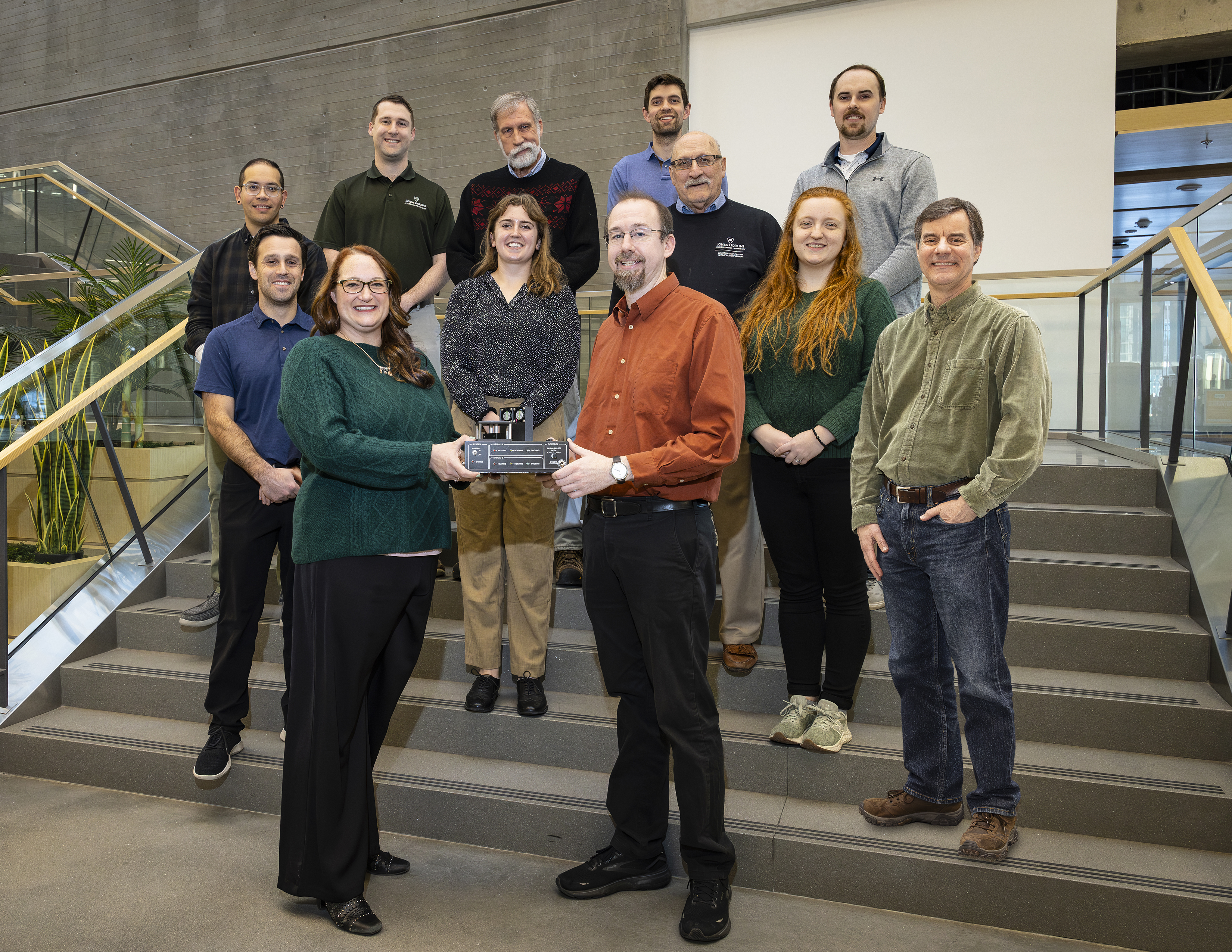
A team of around 100 engineers and scientists at the Johns Hopkins Applied Physics Laboratory has created a shape-shifting antenna that can respond to temperature and works at both low and high frequencies. The idea for the project stemmed from technology included in the science fiction books-turned-TV series, The Expanse, written by James S.A. Corey, a pen name for joint authors Daniel Abraham and Ty Franck.
Science fiction has a long history of inspiring the development of technology. Just look at the communicators featured in old episodes of Star Trek.
“When we got to the point where we could actually do it, there had already been a first draft in the fiction that the science got to follow,” Abraham says.
Now, The Expanse is part of what he calls the “virtuous cycle” of inspiration for science and science fiction, but the story began long before engineers solved a major limitation of antennas.
A plan for pizza
When Abraham graduated from UNM with his degree in biology in 1994, he took a job working in IT for an internet service provider in Albuquerque. In his free time, he wrote fantasy novels and was active in the tabletop gaming community. It was through tabletop gaming that he met Franck, a fellow gamer who had recently designed his own sci-fi role-playing game. Abraham found immediate creative inspiration from the fascinating and extensive new world Franck built in his game. When he approached him about turning it into a book they could sell for extra pizza money, Franck was on board.
The plan for pizza money turned into nine successful novels and several short stories, then the six-season show, The Expanse. The series ran on Amazon Prime from 2015 to 2022.
In the series, there is a new, alien protomolecule that can self-heal and change shape. Characters in the story use the molecule to build highly responsive and resilient ships and weaponry. The novel technology presents challenges as characters grapple with colonization and the social order beyond Earth. Dreaming up new alien species and imagining strange new biospheres was a process made easier by Abraham’s understanding of biological systems and evolution.
“The thing that was wonderful about the biology degree was it informs a worldview. It shows up in the writing because it shows up in my whole life,” Abraham says. “The things that I learned there, the lens that I have to make sense of the world, is formed in large part by the education that I got.”
Years later, another UNM graduate would work on the research team bringing technology inspired by Abraham and Franck’s work to life.
An idea brought to life
As so often happens with science fiction, innovation dreamt up in story can serve as inspiration for real-world advancement.
Jennifer Hollenbeck, an antenna design expert and assistant group supervisor at the Johns Hopkins Applied Physics Laboratory, has been an avid reader her whole life. While “ripping through” the books in The Expanse series, Hollenbeck spent a lot of time imagining how elements of the story could be possible in the real world.
“The topics were all believable, but the authors kind of leave it to the reader to fill in the blanks, so I would spend a lot of time imagining how things could be possible, the reality of what they were proposing,” she says.
With more than two decades of experience in computational electromagnetics, Hollenbeck sees antenna design as both a science and an art, requiring expertise in math, physics and computational software. From cellular networks to wi-fi, antennas are involved in much of the technology we use today. The problem is that present-day antennas are inflexible and complex. More than a challenge, this design constraint has long been viewed as an inherent trait of the technology.
“With antennas, you’re always kind of stuck with what you’ve got, so it may not work exactly the way you want it to,” Hollenbeck says. “You can change the antenna, which can be incredibly inconvenient if it’s on a satellite in space and you don’t have access to it or you’re out in the field as a warfighter.”
Around the time she read the final books, the laboratory put out a call for new project proposals. Reading about the alien molecules in the Expanse books had opened her mind to think beyond the implied engineering constraints of her work. What if she and her colleagues could engineer an antenna that could change on demand? Hollenbeck teamed with Additive Manufacturing expert, Steven Storck, to propose the first antenna prototype that could do what was once considered impossible – change shape on demand and on the fly.
Five years after the creation of their first prototype, the research team, made up of experts spanning the fields of advanced additive manufacturing, physics and electrical engineering, published on their shape-changing alloy antenna in American Chemical Society (ACS) Applied Engineering Materials in 2024.
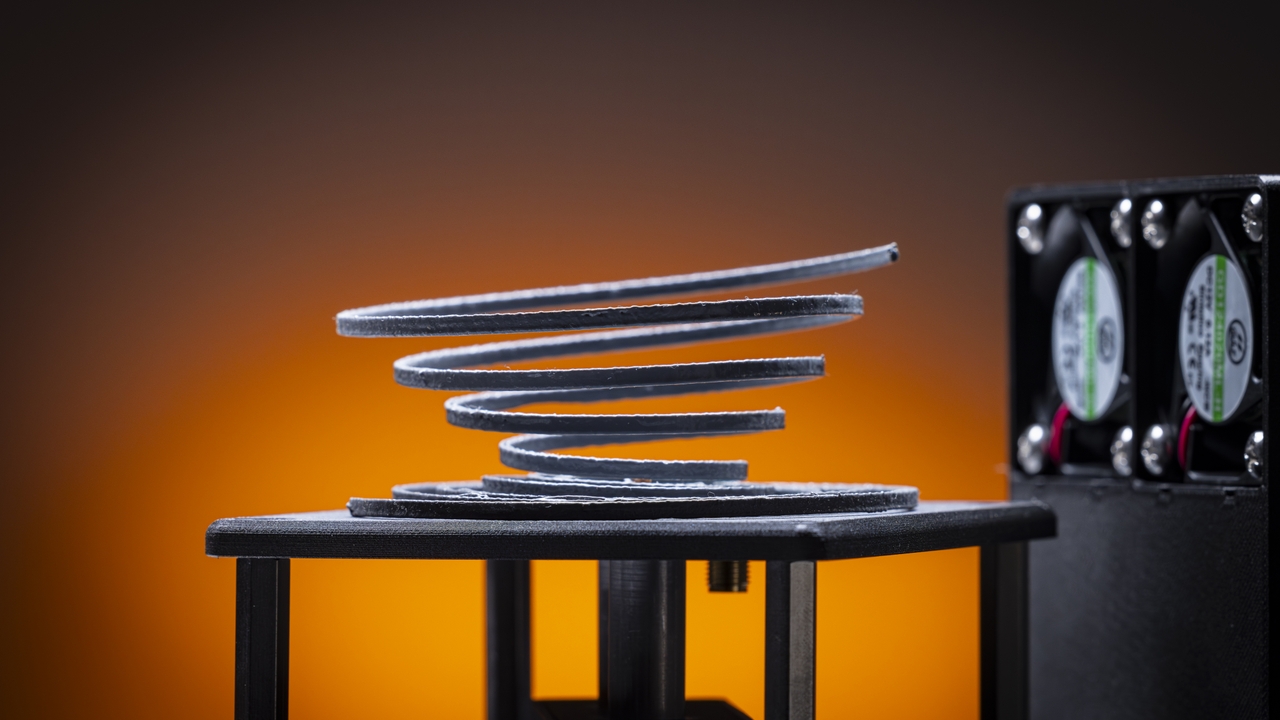
The antenna is composed of 3D-printed nitinol, a shape memory alloy of nickel and titanium. It can fold up, similar to origami, or it can change in two directions based on temperature. A groove on the inside of the antenna, made possible by 3D printing, allows for the placement of a heating wire, allowing for the shape changes to occur. This ability to change shape allows the antenna to operate at both low and high frequencies — a groundbreaking development for the electronic device.
A surprising UNM connection
Among the team leads was Michael Sherburne, who earned his Ph.D. at UNM in 2022 in electrical engineering, with a focus in applied electromagnetics. Sherburne is the advanced technology section supervisor for the Electronic Warfare Advanced Development Group at APL and an Air Force veteran. His Ph.D. was advised by Edl Schamiloglu, distinguished professor in the Department of Electrical and Computer Engineering and director of the UNM Directed Energy Center.
“He was very supportive when I really needed the help, but he also gave me the freedom to do a lot of my own original research while working with other folks with different skillsets,” he says. “I really had the opportunity to learn how to learn.”
That ability came in handy when Sherburne joined the laboratory and was immediately assigned to the complex antenna project. Joining required him to learn new skills while drawing back on the fundamentals of his field. He supported development of the “science that happens between the signal antenna and the hardware,” as Hollenbeck describes, working on electronics and circuitry that support its operation. When Hollenbeck, the principal investigator on the project, ended up with long COVID in 2023 and was out for six weeks, Sherburne stepped up to help keep the project moving forward.
“He really got thrown right into the deep end and showed us how capable he is,” Hollenbeck says. “When I was out unexpectedly, he picked the project up and kept it going.”
When they published their initial results last year, Sherburne knew that The Expanse had inspired the project, but when he learned one of the authors was also a Lobo alum, he wanted everyone to meet. He reached out to The Expanse TV series showrunners about the connection, who put him in touch with Abraham and Franck. The research team got a chance to speak to the authors virtually about how science fiction can inspire real technologies that can then inspire more science fiction.
“Having our team talk to the creators of the series was a major morale boost and inspiration to continue working hard on the technology,” Sherburne says. “To know that our technology’s impacts are not just relegated to the walls of academia and laboratories made everyone feel good about it.”
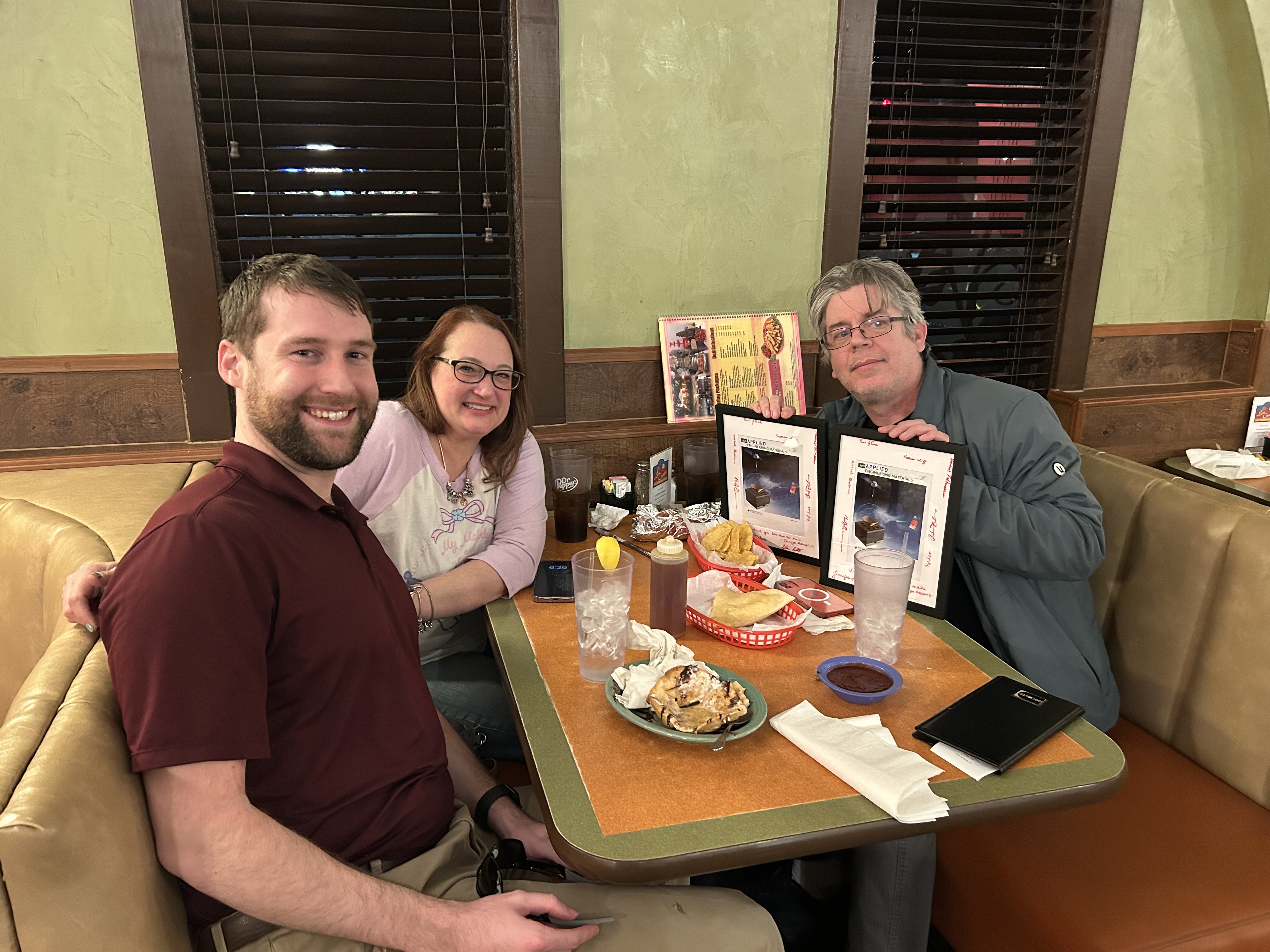
In February 2025, Hollenbeck, Sherburne and Abraham all found themselves in Albuquerque at the same time and met for dinner, where the researchers demoed the antenna prototype using the only heat source available –– a hot fajita plate Sherburne was eating from.
“There’s this symbiotic thing between science fiction writers and engineers,” Hollenbeck says. “When we met we had such an amazing exchange.”
The researchers also gave Abraham two signed copies, one for him and one for Franck, of the ACS journal cover art as a thank you.
Even after the collision of science and fiction, the work continues. Abraham and Franck released the sequel in the James S.A. Corey series, The Captive's War, earlier this year. All the while, the team at the Applied Physics Laboratory continues to iterate on its work with hope the groundbreaking antenna may one day be deployed to solve real-world challenges.
“Hopefully, as scientists and technologists make their stuff, as they create this new possible future for us, there will be other science fiction writers who are inspired by the things that get made, and they can keep this whole process going,” Abraham says.
This story is featured in the 2026 edition of UNM Engineering, the School of Engineering's annual magazine. Read more stories in the online edition at engineering.unm.edu/magazine.


