
In an era ruled by kings and queens, a University of New Mexico history graduate student is shedding light on a medieval Iberian royal couple, revealing how they defied convention and reshaped the mindset of their time.

Jonathan Seyfried is a second-year Ph.D. student in UNM’s History Department who found a passion for high school teaching early on in his career; however, he has always had a dream of pursuing historical research. So, he decided to do something about it, and by the fall of 2023, Seyfried was fully admitted to UNM’s Department of History graduate program. Over the last two years, he has collaborated with fellow graduate students and faculty and is immensely grateful for the camaraderie and supportive environment.
It is with this support that Seyfried submitted research for consideration for the Alan DuPont Breck Award by the Rocky Mountain Medieval and Renaissance Association (RMMRA) - and won.
“I am honored to receive this award. It is incredibly rewarding to have my research recognized in this way,” said Seyfried.
The award recognizes the best paper by a junior scholar. As the winner, he received a $300 cash prize, the option to publish the paper in the Association’s online journal Quidditas, as well as recognition at the annual awards ceremony.
In January, Seyfried’s Medieval Hypebeast: The Conspicuous Consumption of Joan I of Aragon was published in Quidditas.
Seyfried’s research is specific to King Joan I of the Crown of Aragon and his queen Violant de Bar. They ruled from 1387 to 1396. Many prominent historians of the Crown of Aragon deemed their reign a failure, but recently it has inspired new interest. Joan and Violant ruled during a time with a very conservative mindset. They pushed these boundaries by encouraging gender nonconformity in each other by embracing French culture, reversing traditional political roles, and taking risks with their financial management. They spent more money on arts and cultural items from outside the Crown than their predecessors. However, in other circles, they are praised because of their strong support for music and are seen as inspiring musical innovation.
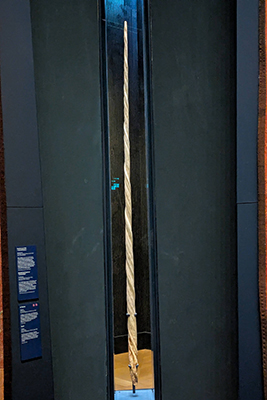
One of the most surprising finds in Seyfried’s research to date is what King Joan called “unicorn horn.” He would do anything to obtain it, spending large sums of money. Joan would use it for medicinal uses by grinding it into a fine powder for his tea. Today, Seyfried understands the “unicorn horn” to be a narwhal tusk, and as everyone knows, it’s a tooth!
Seyfried believes that researching and understanding how Joan and Violant worked together is important to understanding and finally being able to reconcile the opposing views of their reign. He plans to read through the many letters they wrote to each other to help understand the two opinions.
“I hope my research will help deepen our understanding of the Middle Ages by shedding light on King Joan’s often overlooked influence. Joan and Violant challenged the traditional rules of their time, and I want to help bring their impact to a wider audience.”
Over this past year, Seyfried has found a passion for presenting his research at conferences and has a busy 2025 planned. He is set to return to RMMRA’s summer conference and will also present at the International Congress on Medieval Studies in Kalamazoo, Michigan, and the International Medieval Congress in Leeds, U.K.
To learn more about Seyfried’s research, visit his website profile.


