The most recent Level 2 cohort of the UNM Grand Challenges program recently completed its two-year program addressing challenges related to child health, a just transition to green energy and sustainable space research.
In September 2023, UNM selected those three teams for the first ever Level 2 Grand Challenges program. Each team focused on a different challenge, with a shared commitment to address complex interdisciplinary issues facing New Mexico and the world. The three selected teams had all participated in Level 1 of the program, focused on supporting the development of nascent teams as they work towards larger research agendas. Level 2 program participation helped the teams build partnerships, attract external funding, and create longer term plans to continue their work at UNM.
“This program continues to define the opportunities made possible when transdisciplinary research occurs both within and beyond the confines of academic research spaces,” UNM Vice President for Research Ellen Fisher said. “One of the first things I tell these teams when they are selected is that success is measured not only by the amount of grant funding secured, but more importantly by the students who participate, the community voices included, and the researchers from different disciplines who collaborate on different aspects of the same challenge to drive meaningful change.”
Child Health
The Child Health team focused on one of New Mexico’s most urgent and difficult challenges, child maltreatment. New Mexico consistently reports child maltreatment rates above the national average. According to data from the New Mexico Children's Cabinet in 2022, the state recorded 12.5 substantiated child maltreatment victims per 1,000 children, compared with 7.6 nationally, while more than 83 referrals per 1,000 children were made to child welfare authorities. Prior research shows, however, that welfare reports of child maltreatment rates under-represent the true scope of the problem, in part because many cases are never reported.
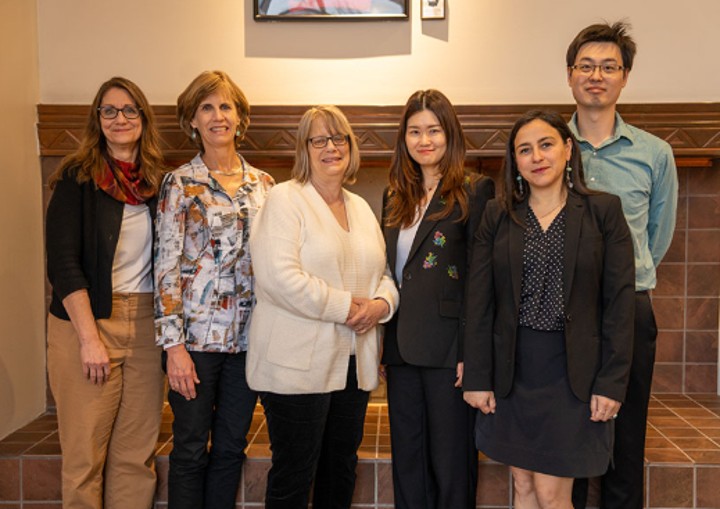
The team successfully conducted the first statewide survey of child maltreatment experiences in New Mexico. Uniquely, the survey also included questions about community and cultural connectedness to elucidate potential protective factors such as community or culturally based support elements important to New Mexicans. The survey provided researchers, service providers, and policymakers with a broader picture of abuse and neglect as well as protective factors supporting resilience. This work was supported by $500,000 in congressionally directed funding and a $300,000 grant from the W. K. Kellogg Foundation. In addition to supporting UNM researchers involved in the survey, the funding supported:
- A multicultural advisory group who provided invaluable insights for the design and implementation of the survey
- A related project on New Mexican attitudes on young child discipline
- An ongoing study of faith healer approaches to supporting families who have experienced child maltreatment
In the discipline study, researchers surveyed parents and early childhood providers across 13 New Mexico counties. They found widespread use of positive discipline, such as praise or rewards for good behavior. The use of corporal punishment varied by region and was strongly connected to parents’ own childhood experiences. Researchers also found high levels of parental stress and concern for children’s well-being, pointing to a continued need for support of New Mexico families with young children.
Another project examined demographic characteristics and risk factors associated with child deaths and near-deaths resulting from violence or maltreatment. By comparing fatal and nonfatal cases, the team is helping build a stronger foundation for prevention efforts.
In February 2025, a Child Health researcher received $317,000 from the Conrad N. Hilton Foundation to examine factors that influence family recruitment, participation and retention in statewide early childhood home-visiting programs. Team members also received a $17,000 Brindle Foundation grant to pilot a program that teaches parents about the role of play in children’s cognitive and social development. Based on the pilot findings, the researchers hope to conduct a larger study involving foster parents.
The Child Health team is building a more comprehensive understanding of child maltreatment and protective factors in New Mexico, creating evidence that can inform prevention strategies and child and family support programs. From September 2023 through June 2026, the team reported $1.84 million in external research funding and six peer-reviewed publications that were accepted, submitted, or in progress.
The team’s next goal is to establish a campus center focused on child maltreatment prevention and intervention. The proposed center would bring together the multidisciplinary research team developed through Grand Challenges.
“Child maltreatment is a complex health and social issue that requires a comprehensive approach,” said Rebecca Girardet, professor in the UNM Department of Pediatrics and a Child Health team co-convener. “The Grand Challenges program helped foster the multidisciplinary research team needed for this work. The proposed center would bring that team together with the UNM School of Medicine’s Section on Child Safety and Well-Being to provide research, clinical services and education that support New Mexico’s efforts to prevent child maltreatment.”
Just Transition to Green Energy
The Just Transition to Green Energy team conducted research related to New Mexico’s shift from fossil fuels to more sustainable energy sources and how that shift impacts workers and communities across the state. For many New Mexico communities, the transition affects not only jobs but local tax bases and the long-term health of regional economies. Among the team’s most visible contributions was research on oil and gas workforce conditions and training needs in southeastern New Mexico. The Southeastern New Mexico Oil and Gas Workforce Study drew attention from local and national media.
The team also studied the experiences of 28 New Mexico local governments – including counties and municipalities -- and community-based nonprofit organizations seeking federal climate funds. That work is helping identify practical barriers communities face when trying to access funding for climate and energy projects. Team members also shared their preliminary insights with New Mexico policymakers, and team members provided technical input on the legislation that established the Community Benefit Fund and State Match Fund. The Community Benefit Fund directs more than $200 million dollars toward locally driven projects focused on clean energy, infrastructure, workforce development, and community resilience, whereas the State Match Fund helps New Mexico communities secure federal grants by providing required matching funds and implementation support.
A third major team effort focused on the Energy Transition Act, New Mexico’s policy framework for supporting communities affected by the closure of coal-fired power plants. The team began a community-engaged assessment that included interviews with workers and stakeholders connected to the closed San Juan and Escalante power plants. That work combines firsthand experience with legal and policy analysis to better understand what helps or hinders implementation of support for impacted communities.
“The Grand Challenge program allowed us to coalesce as a team and to learn how to work together across our teams in this new field of study,” said Gabe Pacyniak, professor in the UNM School of Law and a Just Transition team co-convener, “Now we are better positioned to conduct research and provide support to New Mexico communities as they navigate this transition.”
The team received $1,178,596 in research funding and produced seven publications and in-depth reports. More importantly, the work has helped position UNM as a trusted partner for communities, policymakers, workers, and funders striving for a more equitable future for the workforce and communities impacted by moves toward greener energy sources.
The team now operates out of the new Community-Engaged Energy Transition Institute, housed in the Center for Social Policy on central campus. The institute establishes a hub of research, applied evaluation, and policy work related to energy transition at UNM.
Sustainable Space Research
New Mexico has an extensive space heritage with many pioneering events throughout its history. Based on this historic foundation, the state has a growing space research environment at universities and colleges, national laboratories, commercial space enterprises, and state facilities.
One of the team’s central accomplishments was the establishment of the Center for Advanced Sample Analysis of Astromaterials from the Moon and Beyond (CASA Moon), a NASA Solar System Exploration Research Virtual Institute node established at UNM in 2023. CASA Moon brings together sample measurements, experimental studies, remote sensing and modeling to better understand the geologic evolution of the Moon and explore its resources. It also supports training programs for future planetary scientists and creates opportunities for broader public participation in lunar exploration.
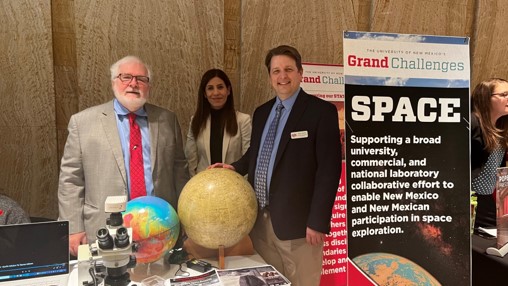
With Level 2 Grand Challenges funding, the team funded eight pilot projects that advanced UNM-led space research across disciplines. The pilot projects supported graduate and undergraduate researchers, helped seed new grant proposals and opened new research directions tied to space systems, propulsion, materials, and lunar exploration.
Another major team effort, UNM EcoLuna, brought together faculty and students from the School of Engineering and the Departments of Architecture and Earth and Planetary Sciences to participate in NASA's Luna Recycle Challenge. The project explored recycling systems for long-duration lunar missions, including approaches for converting waste materials into useful resources. The research team plans to continue to pursue this as a future research opportunity.
The team’s impact extended well beyond the UNM campus. In June of 2026, the team hosted a collaborative Space Event that brought representatives from state universities and national laboratories, industry partners, educators, and community stakeholders together, aiming to develop a more connected statewide space research network.
Reaching out to all New Mexicans, the Space Science and Research initiative sponsored outreach events tied to the annular solar eclipse, the UNM Meteorite Museum, educator development programs, and public events. The initiative also sponsored Space Art events in partnership with the UNM ArtsLab and the UNM Art Museum. The latter will host a space art exhibit scheduled to open in January 2027.
"The Sustainable Space Research-Grand Challenge allowed us to reach out well beyond traditional academic activities at UNM. The program enabled us to convey the excitement of space exploration through several mediums including elementary school visits, museum and laboratory tours, while participating in several community-based activities located across New Mexico,” said Charles "Chip" Shearer, senior research scientist in UNM's Institute of Meteoritics and co-convener of the Sustainable Space Research team. “These different styles of space outreach illustrated that every New Mexican could participate in our next great adventure beyond Earth.”
The team received $8,657,231 in external research funding, published 32 peer-reviewed articles, produced nine additional publications that are in review or in press, and contributed to a white paper requested by NASA.
The team’s future goals include developing a center for space research on campus, creating an interdisciplinary space certificate program and strengthening ties to NASA, commercial space missions, and future research opportunities in New Mexico.
One program, lasting results
Together, the three teams secured more than $11.6 million in new research funding, produced dozens of publications, launched new research infrastructure, and built partnerships across government, industry, nonprofit organizations, and communities throughout New Mexico. Their accomplishments demonstrate how sustained investment in interdisciplinary collaboration can generate long-term capacity to address some of the state's, and the world’s, most pressing challenges.
In July, UNM announced two new interdisciplinary Grand Challenges teams advancing to Level 2. That expansion underscores what the first Level 2 cohort has already made clear: when UNM invests in collaboration across disciplines and across communities, the result is not only new research insights, but a greater capacity to address the challenges facing New Mexicans and other peoples around the globe.


