Student researchers from UNM's Lobo Language Acquisition Lab, Language Documentation Lab, and Indigenous Child Language Research Center presented at this year’s Indigenous Language Institute Symposium (ILIS) held recently at Sandia Resort and Casino. This year’s theme was The Healing Power of Language.
Melanie Kirk-Lente and Kayleigh Russell presented their poster, “Pueblo Hand Talk and Spoken Pueblo Language,” which highlights ongoing documentation of Pueblo Hand Talk, an Indigenous signed language. They discussed strategies for revitalizing signed Indigenous languages alongside their spoken counterparts in Pueblo communities, emphasizing how respectful documentation supports community well-being and cultural continuity.
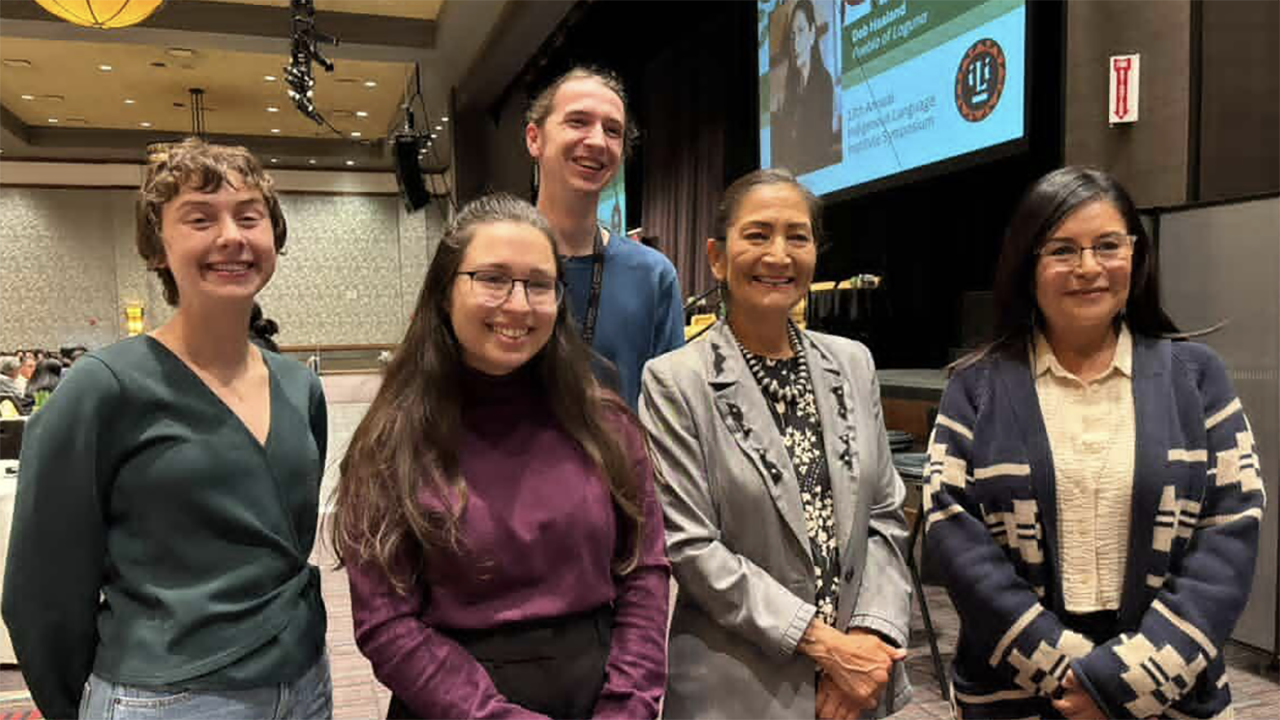
Kirk-Lente and Russell represented the Hand Talk Collaborative, a team led by Professor Jill Morford from the UNM Department of Linguistics, and supported by a 2025-2026 Community-Based Research Award from UNM’s Center for Regional Studies.
Vianne Basulto and Nicholas Underwood each presented research on demonstratives and spatial conceptualization in two Indigenous Amazonian languages, Secoya and Ticuna. Their work comes from a three-year experimental project titled “Addressee Effects in Demonstrative Systems Across Bilingual Communities,” led by Naomi Shin and Rosa Vallejos-Yopán of UNM’s Department of Linguistics, along with Amalia Skilton of the University of Edinburgh. The project, funded by a National Science Foundation grant, explores how bilinguals’ cognition is shaped by navigating two linguistic systems—specifically, how speakers use demonstratives, such as “this” and “that” in English, across different contexts and languages.
Underwood’s poster, “Exploring Language Change in the Amazon,” examined how one Secoya demonstrative has expanded semantically to also function as an affirmation or confirmation. Basulto’s poster, “Talking About Objects in Space in Secoya and Ticuna,” compared how the two languages handle demonstratives and how relationships among the speaker, listener, and referenced object influence demonstrative choice.
Akasha Khalsa and Kirk-Lente presented “Questions and Answers About Child Language Development for Indigenous Language Nests,” which addressed eight common questions from families and community members—such as “When do babies start to learn language?” and “Will being in a language nest make it harder for children to learn the dominant societal language?” They also distributed a handout for community language workers to support nest planning and outreach.
The poster and handout summarize findings from an article in press, “Child Language Development: Questions and Answers for Indigenous Language Nests,” authored by nine researchers. Contributors include MA linguistics students Khalsa, Kirk-Lente, and Kendal Jacobson, as well as faculty members Naomi Shin; Carlos Irizarry-Pérez of the Department of Speech and Hearing Sciences; and Melvatha R. Chee of the Department of Linguistics.


