
Kari Schleher, an assistant professor in the University of New Mexico’s Department of Anthropology and faculty curator of archaeology at UNM’s Maxwell Museum, recently published research examining whether archaeologists can determine the sources of azurite, a vivid blue copper mineral that was used by the Ancestral Pueblo people starting at least 1,400 years ago.

Spheres of blue: Isotopic evidence for the provenance of azurite in the Ancestral Pueblo world was published in the Journal of Archaeological Sciences: Reports, Volume 76 this fall.
This study was a collaboration between Schleher, the lead author, and Alyson Thibodeau of Dickinson College in Pennsylvania, Ryan Mathur of Juniata College in Pennsylvania and Jonathan Till of the Edge of Cedars State Park Museum in Utah.
This synergistic partnership worked well, as each person brought different skills to the study. Schleher brought archaeological expertise, and Thibodeau brought geochemical expertise; together, they helped develop a workable approach to linking archaeological azurite specimens to the mineral's geological sources.
Schleher’s research interests focus on U.S. Southwestern archaeology, specifically the Four Corners region, including work on archaeological pottery and collaborative research with tribal communities.
Because ancient Pueblo communities used azurite as a pigment or paint, Schleher wondered whether the team could develop a method to determine the geological sources of archaeological azurite samples.
“We were curious how far people were traveling to obtain or exchange raw materials they were using in their daily lives,” said Schleher. “This method of examining ancient azurite samples can lead to new understandings of how Ancestral Pueblo people used resources, as well as their movement and exchange across their land.”
The team obtained azurite samples from two important geological sources in New Mexico and Utah, both with evidence of being mined by Ancestral Pueblo people in the past. They then worked with other Southwest archaeologists to identify 12 archaeological azurite specimens from the Four Corners region that could be compared with samples from the geological source locations. Based on prior research on other blue-green minerals, such as turquoise, they used isotopic analyses of lead, strontium and copper to investigate the archaeological samples' locations of origin.
They found that isotopic measurements can determine azurite's original source location, meaning archaeologists can test ancient samples to determine where these communities gathered their azurite. The team determined that most of their azurite samples were likely collected in Lisbon Valley, near present-day Moab, Utah. They also found that two of their archaeological specimens originated in the Zuni Mountains of New Mexico.
“We were very excited when we realized our analysis worked, and we could in fact confirm the origin of the azurite samples,” said Schleher. “We were able to show that Pueblo people would travel from modern-day New Mexico up to today’s central Utah 1,400 years ago.”
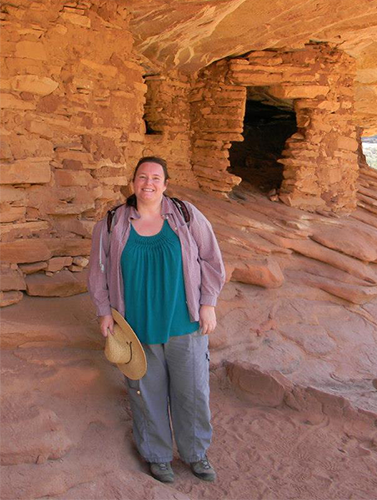
This evidence suggests Ancestral Pueblo communities used azurite from both locations by about 600 A.D., indicating that Pueblo communities traveled or commuted long distances to mine raw materials.
Additionally, the study’s findings show that lead and strontium isotopes are the strongest tracers for linking archaeological azurite to its geological source, and that even though copper is a main element of azurite, copper isotopes could not be used to distinguish between azurite specimens from the different sources in this study.
Schleher and Thibodeau plan to test more samples to increase the sample size and expand their azurite source database.
"We've reached out to the New Mexico Mining Museum; the curator there has identified that he
has a number of azurite samples from different geologic source locations,” said Schleher. “Which would allow us to expand origin sources to compare archaeological samples against.”
Beyond that, she is excited about future collaborations that this project can open. Most notably, she hopes to develop partnerships with Tribal communities in the Southwest to learn what they would like to research regarding azurite.
“What is great is this research can be used in conjunction with Tribal oral histories to show the deep time depth of use of particular mines and demonstrate the extent of traditional territories in the past,” she said.
To learn more about Schleher’s provenance testing method, visit the research journal article’s webpage.
Visit Schleher’s faculty profile to learn more about her overall research interests.


