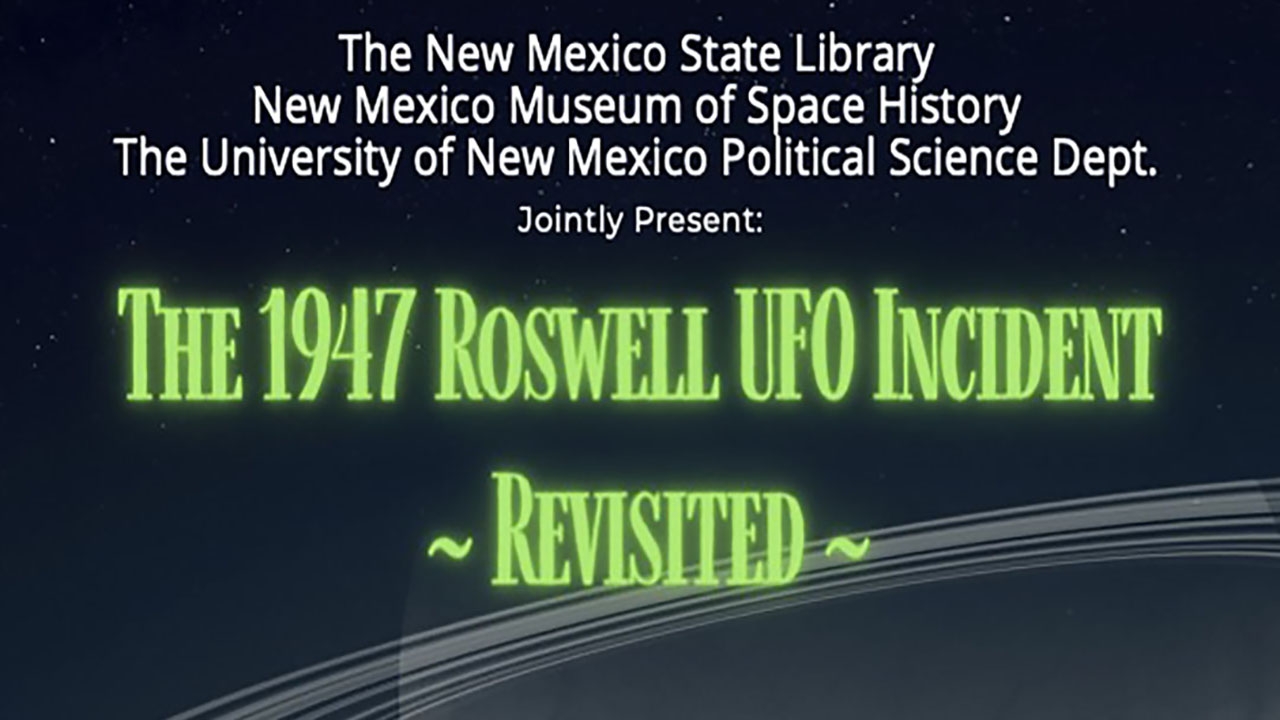
In late June, four University of New Mexico pre-law students presented with the New Mexico Department of Cultural Affairs, the New Mexico State Library, the New Mexico Museum of Space History and UNM for a special online public educational program titled “The 1947 Roswell Incident Revisited: Constitutional and Legal Issues.” The unique and innovative program examined in detail the response to the famous “UFO crash” in Roswell from a legally and socially analytical perspective.
UNM pre-law students Nicole Osborne, Caden Salazar, Tatiana James and Miguel Serna spoke on the educational panel and discussed legal issues that can arise following significant unexpected events through the lens of the Roswell incident. The students' legal and social analysis stemmed from their novel, in-class studies that had been explored in UNM professor Lawrence Jones’ Constitutional Law class, which the four pre-law students all attended together during the Fall 2025 semester. The class utilized materials including video testimonials from numerous people who experienced the Roswell incident -- either as civilians or members of the military -- to discuss what kind of issues could arise based on what they said they experienced in the aftermath, rather than to debate what the true cause of the incident may have been.
“We looked at these video testimonials and said, if hypothetically all of what these people are saying is true, what kind of constitutional issues can arise from this,” Jones explained.
The public program was jointly co-moderated by Kathleen Miles and Susanne Caro of the New Mexico State Library, and Karen Kincaid Brady of the New Mexico Museum of Space History.
As part of the analysis, the student group discussed the historical context of the time of the crash, both in the aftermath of World War II, which had ended just two years prior, and in terms of technology. “ Since this was before television and more quick access media, our knowledge of the event is based heavily on first person accounts, government reports and press releases from that time,” Tatiana James explained. “When you don’t have all the facts, you’re relying on these first-person interviews or testimonies from their children, which is where things get a little bit hazy.”
James also discussed how the incident did not gain the level of long-term national and world renown it has now for nearly 30 years after the incident, when Major Jesse Marcel, who was among the first military officers to officially investigate the debris field, came forward to say he believed the debris to be possibly extraterrestrial.
Osborne shared that the study and constitutional analysis of the Roswell UFO incident “introduced us to the importance of the relationship between the People and government officials. ...The Roswell incident included a lot of questions about the rights of people to know what is occurring on their land, and the rights of people once something does occur on that land, and what information they can share amongst each other (and) share with the media under freedom of the press and freedom of speech. When we’re looking at going into law school, its really important to understand these constitutional boundaries between the rights of the people and the rights of the government.”
Salazar shared his view that “the takeaway from Roswell for most people is whether or not there (is) alien life. But I think there’s something much more concerning that is relevant about it from a legal aspect, and its the power the government has to chill your rights or almost take them away in a lot of cases.”
Serna added some of his personal recollections, stating that, “I remember when I was in high school when (in) my government class my teacher made us always carry around the pocket Constitution. As I’ve grown up, I realize that Bill of Rights is one of the most important things that you will ever have in your life."
Among the many U.S Supreme Court cases the group jointly discussed was Reynolds v. United States, a case that occurred after Roswell, but dealt with the widows of three civilians killed in a military plane crash who filed a wrongful death suit in an attempt to get the accident report released. The U.S Government argued that releasing the report would be a national security risk, and in the end the United States Supreme Court ruled that the report did not need to be disclosed due to the security implications. The question, had the precedent been in place for Roswell, would have been whether the incident qualified as a state secret.
Other relevant U.S Supreme Court cases which the students discussed and analyzed against the backdrop of the historic 1947 Roswell UFO incident included Snepp v. United States (Government-Mandated Silence of Certain Employees in Sensitive Positions), Laird v. Tatum (Military Surveillance of Citizens), New York Times v. United States (The “Prior Restraints” Doctrine) , Bantam Books, Inc. v. Sullivan ( The “Indirect Censorship” Doctrine) , Reed v. Gilbert (Governmental Restriction of Content-Based Speech), Korematsu v. United States (National Security vs. Overreaching Governmental Action), Florida v. Riley (Confidentiality/Privacy vs Open Airspace ) , and Prince v. Massachusetts (Parens Patriae Jurisdiction and Protection of Minors).
After the program, Jones noted the pre-law students’ strong discipline and the professional quality of their legal presentation.
“I am extremely proud of the hard work that Nicole, Caden. Tatiana and Miguel, all put into preparing for and then delivering this public education program about revisiting Roswell 1947 from an extremely different and innovative analytical perspective," Jones said. "These students went well beyond the more traditional walls of a typical Roswell 1947 discussion and provided major food for thought on multiple legal and social considerations. Their work as a team was 100% exemplary, and these students will undoubtedly have excellent futures both in law school and then beyond when they ultimately enter the legal profession as attorneys."
More information on the Roswell incident can be found here.
The 80th anniversary of the historic 1947 Roswell “UFO Crash” occurs next year, on July 2, 2027.


